
So Much Life, So Much Death
One week before we were due to leave for Kenya, I broke my ankle.
Nico and I were playing tennis. I jumped to hit a ball, landed directly on another tennis ball and—
Snap.
Excellent timing.
There was one unexpected advantage. Airports become remarkably efficient when you're in a wheelchair. I was wheeled through terminals, ushered to the front and somehow became the first person both onto and off the aircraft.
I could get used to that part.
Unfortunately, the Maasai Mara is considerably less accommodating to a broken ankle.
The smallest plane I had ever seen
Getting into the Mara was an experience in itself. Our AirKenya aircraft looked small enough to be blown away by a small gust of wind. We would take off, spend what felt like only a few minutes in the air, land on a tiny airstrip somewhere in the Mara to drop off a guest, take off again and repeat.

Eventually, it was our turn.
We landed in the middle of this enormous landscape and were met by Maasai men in traditional dress who had come to collect the arriving guests and their luggage.
There was something wonderfully surreal about stepping out of that tiny aircraft and immediately finding ourselves in the middle of the Maasai Mara.

Mara Siria
We stayed at Mara Siria Luxury Tented Camp, perched high above the Mara. The word tented is important here.
With a freshly broken ankle, getting around airports in a wheelchair had been rather pleasant. Getting to and from our tent over uneven, unstable ground was not.
My timing really had been impeccable.

But from high above the plains, we could look out over the landscape we had travelled all this way to see. We had breakfast overlooking this wilderness, as far as the eye could see.

And what struck me almost immediately was just how much life there was. Abundance
The Great Migration is often described in numbers. Millions of animals moving through the Serengeti - Mara ecosystem. Great herds of wildebeest accompanied by zebra and other grazing animals, following water and fresh pasture.
But numbers don't really prepare you for when you're right in the middle of it.

Zebra gathered across the plains. Wildebeest in numbers that became increasingly difficult to comprehend. Elephants. Cheetah.
Hyena trotted around in broad daylight, their stomachs completely full.
There was an extraordinary abundance to the place. But amongst all that life were bones. Scattered across the earth. That was something I hadn't really considered before travelling to see the Great Migration. If you witness life on this scale, inevitably you witness death on the same scale. Nothing is hidden here.

There is no sentimentality to any of it. Nature simply continues. And nowhere did I understand that more completely than at the river.
The river. I remember the smell. Of everything I could tell you about seeing the Great Migration, that is one of the details that has remained with me most vividly.
The smell of death and blood. Carcasses in the water. So many. Crocodiles so satiated that they became totallly indifferent to most of them. There was simply so much. And above the river, the wildebeest gathered.
One animal stood at the edge.
Behind it were enormous numbers of wildebeest, waiting.
It would approach the edge, hesitate, retreat. The herd waited. Again it would move forward. Again it would stop.
Watching that first wildebeest was almost unbearable because we knew what waited below.
The river.
The current.
The crocodiles.
Death was quite literally beneath them.
And yet behind that single animal was the momentum of the migration itself.
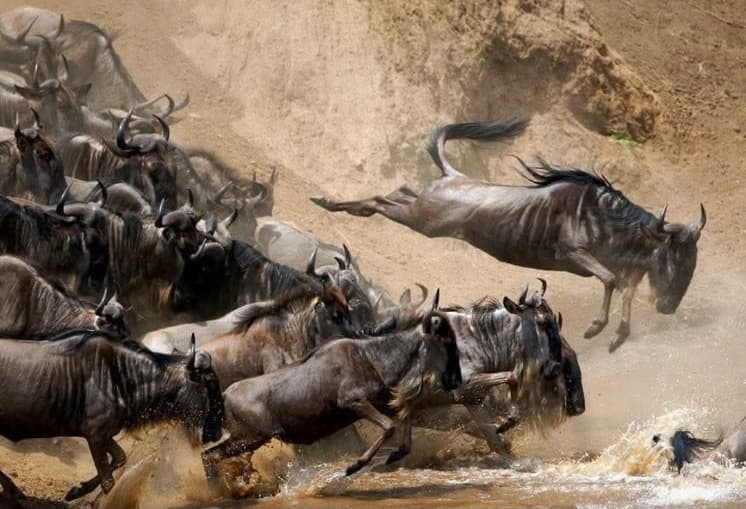
Eventually, one jumped.

And everything changed. The hesitation vanished. Wildebeest began launching themselves from the bank, one after another, the enormous herd suddenly pouring into the river. Dust. Water. Bodies. Noise.
What had been a motionless wall of animals moments earlier became complete chaos.
It was extraordinary to witness.
But I wouldn't describe it as beautiful.
There are parts of nature that are difficult to reconcile with the way we like to imagine it. We talk about its beauty, its balance and its magnificence.
Standing beside that river, I was confronted by something else.
Nature can be ruthless.
The Great Migration is magnificent precisely because it isn't a performance. Nothing is happening for us. There is no concern for whether what unfolds is beautiful or upsetting to watch.
The animals simply have to keep moving.
I will never forget seeing it.
But it isn't the memory from Kenya that I return to when I want to go back.
Surrounded
That happened somewhere out on the plains.
During one of our game drives, our open safari vehicle suddenly found itself surrounded by wildebeest.
Thousands.
They stretched around us in every direction until our vehicle seemed almost irrelevant amongst them. And then there was the sound.
I had seen enormous herds of wildebeest before. What I had never understood was what thousands of wildebeest sound like.
They bellowed and called continuously.
Thousands of individual voices merging into this immense sound that seemed to fill the entire landscape.
And we were sitting in the middle of it.
There was nothing frightening about this moment. Nothing gruesome. Nothing to reconcile.
We simply sat there. Immersed.
Even now, years later, I sometimes take myself back to that moment.
I remember the scale of the herd around us and the strange feeling of being two human beings sitting quietly amongst thousands of animals moving through one of the oldest rhythms in the natural world. But mostly, I remember the sound.
It is one of those incredibly rare experiences where I knew, even while it was happening, that I might never experience anything quite like it again.
And I haven't.
